
Contents:
- What “Proper Care” Actually Means
- Cost Breakdown: What You Are Actually Paying For Over Time
- Common Mistakes to Avoid
- The Role of Extension Hair Quality
You have just spent the better part of Saturday morning in the salon chair, and you are leaving with the hair you have wanted since approximately the age of seventeen. The natural question, somewhere between the payment terminal and the door, is: how long is this going to last? And the more precise version of that question — the one worth asking — is: with proper care, what is the realistic maximum lifespan?
The short answer: bonded and ring-based extensions, properly cared for, should last 3–6 months at the attachment before needing repositioning, with the hair itself remaining in excellent condition for 9–12 months. Clip-in and halo extensions, cared for correctly, can last 2–4 years before replacement is necessary. These ranges assume quality Remy human hair and professional installation — both of which are baseline expectations at a studio such as Ivana Farisei, where the starting specification is higher than the general market average.
What “Proper Care” Actually Means
The phrase “proper care” is used so broadly in extension marketing that it has lost much of its meaning. In practical terms, it translates to four specific habits.
First: dry your hair thoroughly after every wash, particularly at the root zone where attachments sit. Residual moisture at a nano-ring or tape bond creates a microenvironment that degrades the attachment material and, over time, promotes buildup at the root. A cool-to-warm dryer at the root zone adds roughly two minutes to your routine but measurably extends the functional lifespan of the attachment.
Second: brush before washing, never during. Wet extension hair — like wet natural hair — is in its most mechanically vulnerable state. Detangle with a loop brush or a specifically designed extension brush when the hair is dry, from ends to roots, before stepping into the shower. Attempting to detangle wet extensions under running water causes cuticle damage at the extension shaft that is cumulative and irreversible.
Third: use sulphate-free products. Sulphates strip the natural oils that coat both natural and extension hair. Extension hair has no sebum supply from the scalp, so it relies entirely on the products you apply to maintain moisture and cuticle integrity. Sulphate-free shampoo and a lightweight conditioner from mid-lengths to ends (never applied to the attachment zone) are non-negotiable for longevity.
Fourth: protect from environmental stress. Saltwater, chlorine, and prolonged UV exposure all accelerate hair fibre degradation. A protective serum or leave-in treatment before swimming, and UV-protective styling products for extended outdoor exposure, are small investments that materially extend how long your extensions look their best.
Cost Breakdown: What You Are Actually Paying For Over Time
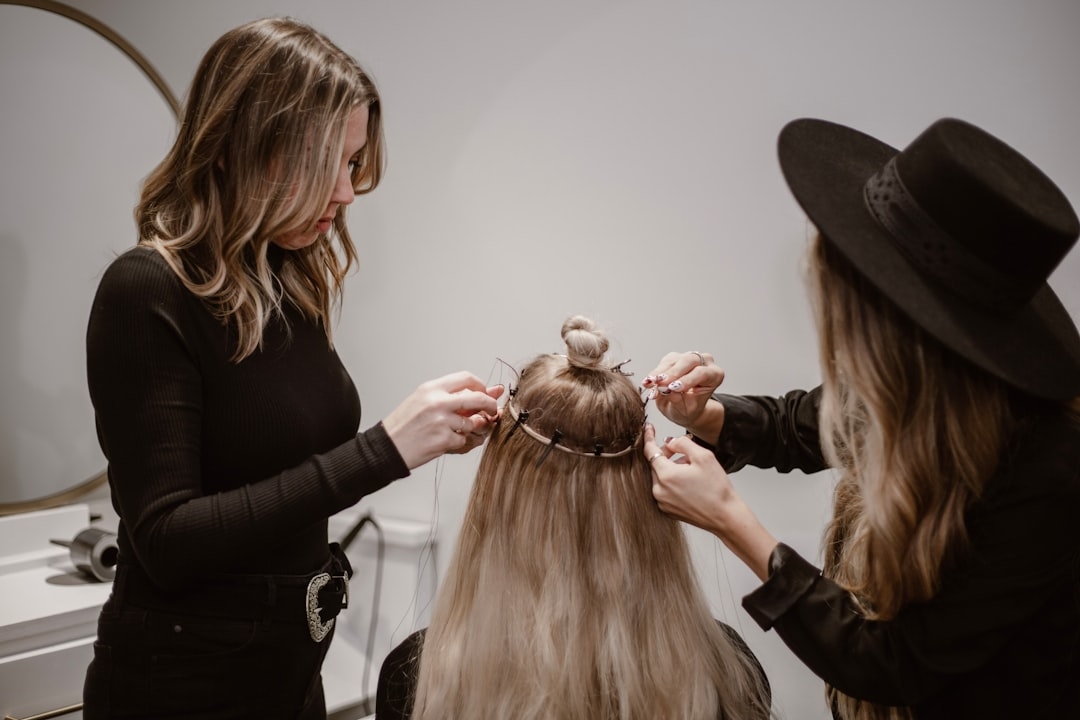
A common misconception is that expensive extensions are inherently better value. The real variable is cost-per-week of good-quality result, which requires knowing both the initial cost and the maintenance cycle.
- Budget tape-in extensions (£150 every 7 weeks, general salon): approximately £21.43/week, with hair quality often declining after the second or third reapplication.
- Mid-range nano-ring (£350 initial + 2 × £100 maintenance, 12 months): approximately £10.58/week.
- Ivana Farisei bespoke nano-ring or microbond (£500 initial + 2 × £120 maintenance, 12 months): approximately £14.23/week, with hair quality consistently maintained across the full 12-month cycle due to the Remy human hair specification and structured aftercare.
- Clip-in set from a quality supplier (£200, used for 3 years): approximately £1.28/week — the lowest cost-per-use of any method, and with no professional maintenance appointments required.
Clients seeking a london hair extension service at Ivana Farisei often find that the cost conversation changes once they see the full-year breakdown. The studio’s complimentary four-week check also reduces the risk of small problems becoming expensive corrections — which is a hidden cost factor that budget calculations rarely include.
For clients who are growing out shorter natural hair and transitioning to extensions, the specific consideration of short hair extensions via ring-based methods is relevant: Ivana Farisei’s technicians can work with as little as 7 cm of natural hair length, which means the investment can begin earlier in a grow-out journey rather than waiting for hair to reach a specific minimum.
Common Mistakes to Avoid
The following are the behaviours most frequently identified by extension technicians as responsible for premature failure. None of them involve complex routines — they are mostly about what not to do.
- Sleeping with hair loose and unwashed: Natural movement during sleep creates friction and tangling at the attachment zones. A loose braid or a silk scrunchie at the nape reduces overnight mechanical stress significantly.
- Applying dry shampoo directly to the bonds or rings: Dry shampoo buildup at the attachment zone stiffens the bond and creates a surface that attracts more buildup over time. Apply dry shampoo to the mid-shaft and ends only, or use a scalp-targeted nozzle to direct product away from attachments.
- Using heavy oil treatments at the root: Argan oil, coconut oil, and similar heavy products break down tape-in adhesive and can cause ring-based attachments to slide. Save intensive treatments for the mid-lengths and ends.
- Delaying maintenance appointments: An attachment that has grown out more than 3 cm from the scalp creates a lever-effect tension on the natural hair every time the extension strand moves. Allowing this to persist over weeks — rather than attending a timely repositioning — is the single most common cause of the hair thinning and breakage that clients mistakenly attribute to extensions as a category.
- Using a standard brush on the attachment zone: Paddle brushes and round brushes snag on rings and bonds and pull the attachment away from the natural hair section. A loop brush or a brush with flexible extended bristles (specifically marketed for extension use) is not optional — it is the difference between a gentle detangle and a damaging tug.
At Ivana Farisei, the aftercare consultation at the end of each installation specifically covers these points in a personalised context. A technician who knows whether you swim regularly, use the gym daily, or colour your hair at home will give you a significantly more useful care plan than a generic printed leaflet — and this level of personalisation is one of the reasons Ivana Farisei clients report fewer premature failures than the industry average.
The Role of Extension Hair Quality
No amount of correct aftercare compensates for poor-quality extension hair. The Remy human hair used by Ivana Farisei is cuticle-aligned — all scales run root to tip, which prevents the internal friction that causes tangling and matting in cheaper alternatives. Lower-quality “human hair” is often a blend of shed hair and synthetic fibre, chemically stripped and silicone-coated to appear glossy at point of sale. This coating washes off within 3–4 weeks, after which the underlying poor-quality fibre degrades rapidly regardless of how carefully the client maintains it.

The hair extensions micro bonds available at Ivana Farisei use strands that can be identified by their consistent texture across the full length — a characteristic of genuinely cuticle-aligned Remy hair that is visually and tactilely distinct from coated alternatives. When evaluating any extension supplier, ask specifically whether the hair is cuticle-aligned Remy — and ask what happens to the texture after the first five washes, as that is the honest test of material quality.
Hair extensions, maintained correctly and applied with quality materials, are not the high-maintenance proposition they are sometimes portrayed as. The daily habits involved are minor adjustments to what most people already do; the periodic professional appointments are comparable in frequency to a colour refresh. The outcome — hair that looks consistently full and healthy across an entire year — is a straightforward return on a considered investment.